

Pawapay Rest Api Vs Python Sdk: Fastest Production Path
Date: 2026-04-30 || Views: 699
REST API vs. Python SDK: The Fastest Path to Production
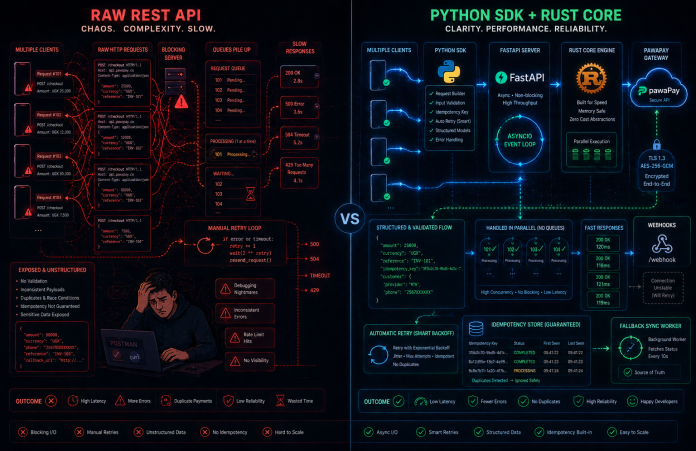
Integrating an African mobile money gateway presents a distinct architectural choice: constructing raw HTTP requests directly against the provider's REST API, or utilizing a dedicated, language-specific SDK. While interacting with the raw REST API offers absolute foundational flexibility, building a production-grade financial integration from scratch is fraught with hidden complexities. This benchmark comparison dissects the structural differences between these two approaches to determine the most performant, secure, and resource-efficient path to deploying PawaPay.
The Hidden Overhead of Raw REST Integration
Building a direct REST integration is often deceptive in its initial simplicity. Developers begin by writing standard HTTP POST requests, but quickly encounter the realities of high-stakes financial networking. A robust REST implementation requires the engineering team to manually construct and tune connection pools, implement exponential backoff for unpredictable network timeouts, and manually parse complex, nested JSON responses. Furthermore, every outgoing payload necessitates custom validation logic to prevent malformed data from reaching the gateway.
Perhaps the most significant burden lies in the security implementation. Cryptographic signing, header generation, and TLS negotiations must be implemented flawlessly in plain-text Python. This approach transforms a supposedly simple integration into a sprawling maintenance burden. Your engineering team becomes responsible for continually patching edge cases, normalizing raw mobile network operator error codes into actionable logic, and mitigating the memory overhead inherent to standard synchronous HTTP libraries.
The Native SDK Advantage
Contrast this raw approach with the architecture of the pawaPay Python SDK. By utilizing a "Thin Wrapper / Fat Core" model, the SDK eliminates integration boilerplate entirely. Instead of wrestling with raw headers and manual JSON serialization, developers interact with clean, asynchronous Python methods backed by strict Pydantic type validation.
The true advantage lies beneath the Python surface. The SDK’s compiled Rust core autonomously handles the operational heavy lifting. It executes HMAC-SHA256 signature generation in a memory-safe environment, negotiates secure TLS 1.3 handshakes, and manages highly optimized connection pools far more efficiently than interpreted Python scripts. By abstracting the complex protocol-level interactions, the SDK ensures that your application logic remains pristine, readable, and strictly focused on business fulfillment.
Asynchronous Throughput and Performance
When benchmarking throughput, the architectural differences become stark. Custom REST integrations built on traditional, synchronous libraries block the main execution thread during every network round-trip. When communicating with African telcos, these round-trips can suffer from unpredictable latency. Under heavy checkout loads, this synchronous blocking behavior rapidly exhausts server worker threads, causing the application to drop connections and buckle under pressure.
The pawaPay SDK bypasses this fundamental bottleneck by leveraging Python's native asynchronous framework coupled with a highly performant Rust HTTP client. This non-blocking architecture allows a single server node to initiate thousands of concurrent mobile money deposits. When an asynchronous SDK method is called, it instantly yields control back to the event loop while awaiting the gateway's response. The result is a radically higher throughput capacity, minimal memory consumption, and a surgical resilience to external network latency.
Security and Long-Term Maintenance
Maintaining a bespoke REST integration requires constant vigilance against API version deprecations, shifting security protocols, and evolving webhook structures. Furthermore, keeping cryptographic logic exposed in interpreted Python scripts leaves the integration vulnerable to internal tampering or dependency hijacking.
The premium SDK neutralizes these risks by encapsulating all critical security mechanics within an immutable, bytecode-obfuscated Rust virtual machine. By abstracting the cryptography and standardizing the error handling natively, the SDK drastically reduces your application's attack surface. It effectively shifts the maintenance burden of gateway updates, security patching, and protocol optimization away from your internal engineering team and onto the SDK maintainers.
The Verdict
While building a bespoke REST integration from the ground up offers total theoretical control, it represents a massive and inefficient allocation of engineering capital. For teams prioritizing speed-to-market, transaction integrity, and high-concurrency performance, the pawaPay Python SDK provides a surgically optimized pathway to production. It transforms months of complex architectural development and security hardening into a streamlined, highly secure implementation, empowering businesses to focus exclusively on product growth rather than gateway maintenance.
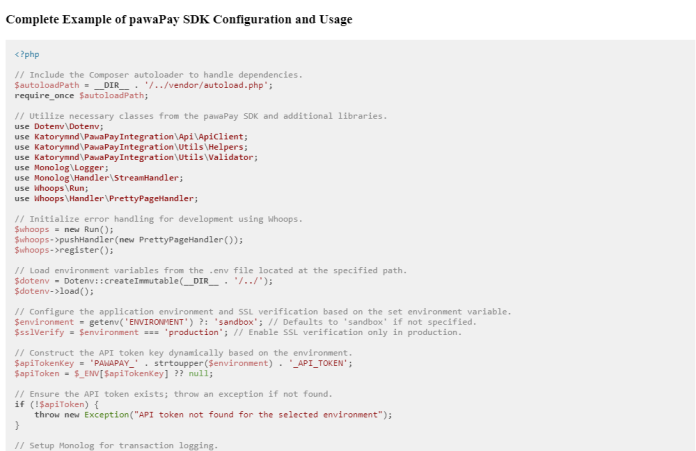
A step-by-step guide to configuring pawaPay SDK, from installation to...

Website design in Canberra starts at A$300. WordPress-powered solutions, plus...

Glimpses of Greatness Crafted by Katorymnd
Dive into the journeys of clients I've empowered.
Click any project below to explore the results - each one a story of transformation.
pawaPay Java SDK - Payment Integration


pawaPay Java SDK: Seamless enterprise mobile money integration for Java applications. Features robust typing, thread-safe execution, and reliable transaction handling.
pawaPay Python SDK - Payment Integration
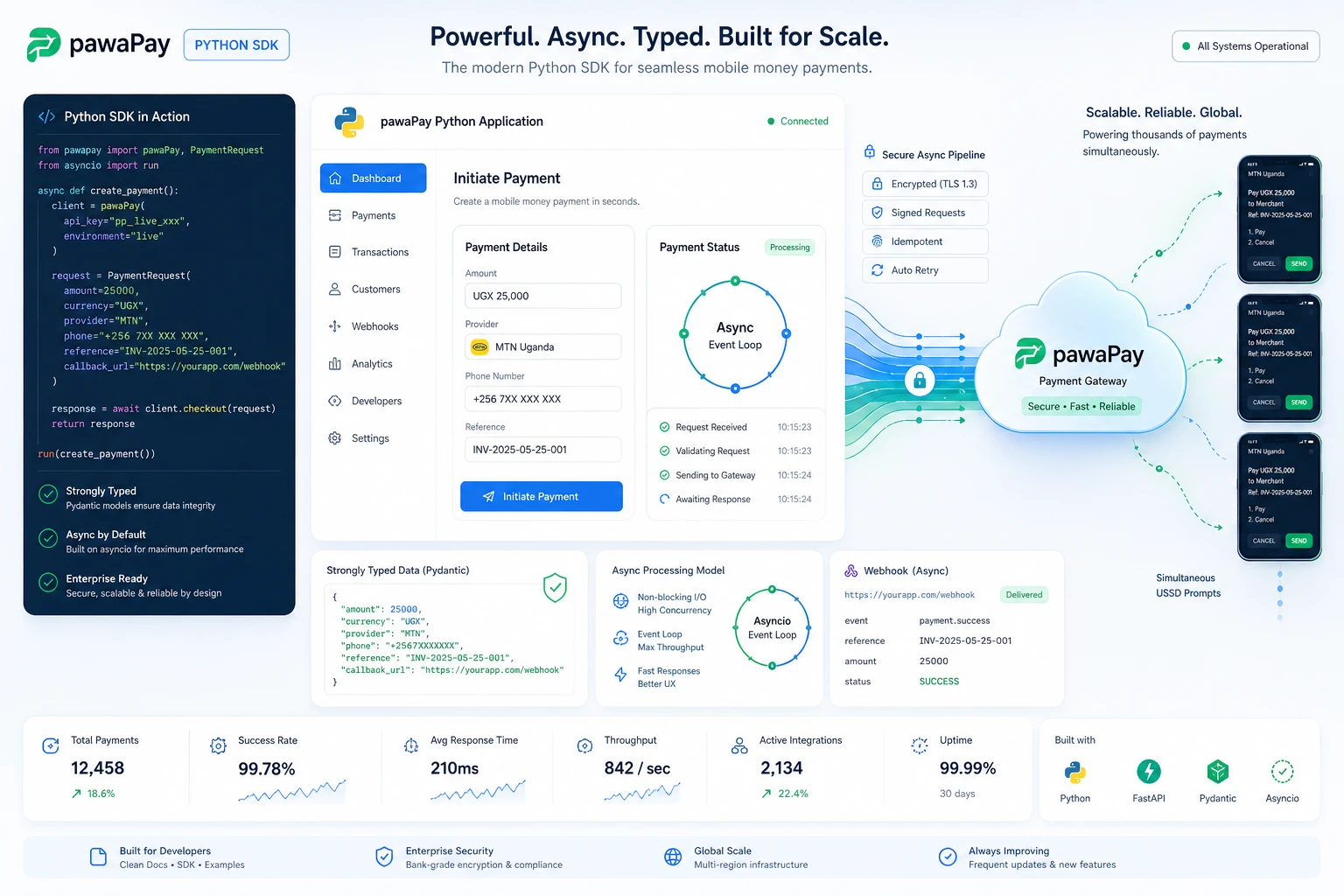
pawaPay Python SDK: Seamless enterprise mobile money integration for Python applications. Features robust typing and asynchronous transaction handling.
pawaPay Node.js SDK, Payments
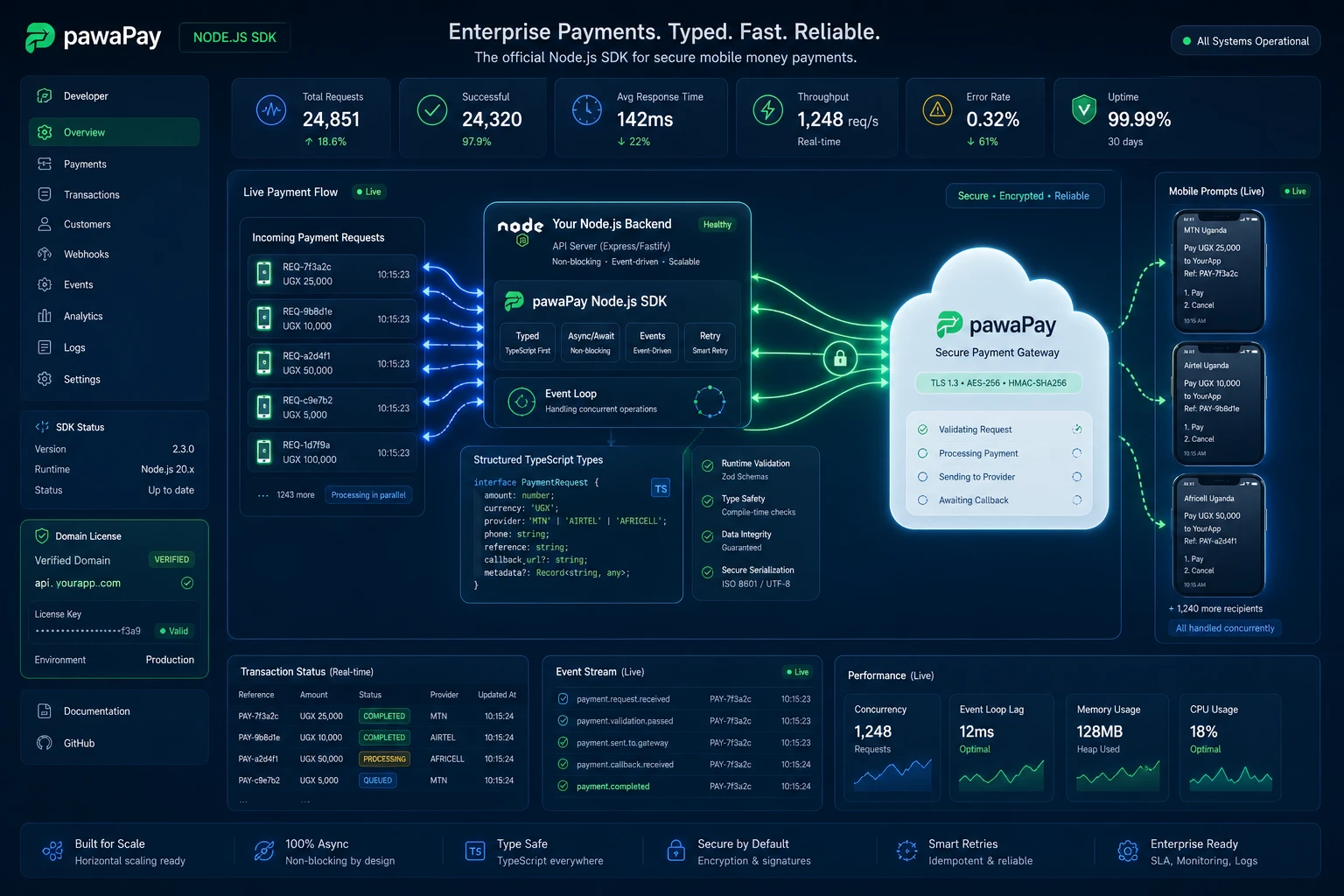
pawaPay Node.js SDK: Enterprise mobile money integration for Node.js & TypeScript. Strictly typed, async wrapper with simple domain-based licensing.
Clean My Mind - A Quiet Release

A privacy-first web ritual, no signup, say one sentence and let it go. Built with vanilla JavaScript, local-only storage, and focused on presence rather than analytics.
Professional Services
© Copyright 2026 - Katorymnd Web Solutions - All Rights Reserved. Registered with Uganda Registration Services Bureau.