

Experience the Raw Power of the Pawapay Node.js Sdk
Date: 2026-01-18 || Views: 1,409

Beyond Documentation: Experience the Raw Power of the PawaPay Node.js SDK
When Documentation Isn't Enough: The Professional's Edge
You've read the documentation. You've seen the API endpoints. But there's a chasm between knowing the endpoints and wielding transactional power at scale. The PawaPay Node.js SDK isn't just another wrapper-it's your surgical instrument for financial operations across Africa's mobile money ecosystem.
Let's bypass the theoretical and dive straight into what matters: production-ready patterns that work.
Initialization: The Foundation of Resilience
const { ApiClient, Helpers } = require('@katorymnd/pawapay-node-sdk');

class PaymentService {
    constructor(config = {}) {
        // you  can name these `PAWAPAY_SANDBOX_API_TOKEN`,`PAWAPAY_PRODUCTION_API_TOKEN` as you  want
        const activeToken = process.env.PAWAPAY_SANDBOX_API_TOKEN; // change to (PAWAPAY_PRODUCTION_API_TOKEN)

        this.pawapay = new ApiClient({
            apiToken: activeToken,
            environment: 'sandbox', // change to production / sandbox
            licenseKey: process.env.KATORYMND_PAWAPAY_SDK_LICENSE_KEY, // required as is
            sslVerify: false  // true -> production
        });


    }
}
Professional Insight: The sslVerify: false flag? That's for sandbox testing-always toggle this in production.
Deposits: From Simple to Sophisticated
Direct Mobile Money Deposit
async deposit(paymentData, apiVersion = 'v2') {
    const depositId = Helpers.generateUniqueId(); // SDK utility

    // Surgical validation
    const { amount, currency, mno, payerMsisdn, description } = paymentData;
    if (!amount || !mno || !payerMsisdn) {
        throw new Error('Essential fields: amount, mno, payerMsisdn');
    }

    // Execute based on API version
    const response = apiVersion === 'v2'
        ? await this.pawapay.initiateDepositV2(
            depositId, amount, currency, payerMsisdn, mno, description
          )
        : await this.pawapay.initiateDeposit(
            depositId, amount, currency, mno, payerMsisdn, description
          );

    // Response handling pattern
    if (response.status >= 200 && response.status < 300) {
        return {
            success: true,
            transactionId: depositId,
            status: 'SUBMITTED',
            nextStep: 'poll_status'
        };
    }

    // Error extraction (using SDK's FailureCodeHelper)
    const failureCode = response.response?.failureReason?.failureCode;
    const errorMessage = FailureCodeHelper.getFailureMessage(failureCode);

    throw new Error(`Deposit failed: ${errorMessage}`);
}
Key Pattern: The dual-version support (v1/v2) demonstrates forward compatibility. The Helpers.generateUniqueId() ensures transaction uniqueness-critical for idempotency.
Payment Pages: Hosted Checkout Experience
async createPaymentSession(checkoutData) {
    const sessionId = Helpers.generateUniqueId();

    const { amount, currency, returnUrl, description } = checkoutData;

    // V2 session creation
    const response = await this.pawapay.createPaymentPageSessionV2({
        depositId: sessionId,
        returnUrl, // Mandatory for redirect flow
        customerMessage: description,
        amountDetails: { amount, currency },
        metadata: [{ orderId: "CART-123" }]
    });

    if (response.status === 200) {
        return {
            sessionId,
            redirectUrl: response.response.redirectUrl,
            // Customer redirects here for payment
            status: 'SESSION_CREATED'
        };
    }
}
Critical Note: The returnUrl is non-negotiable. This is where customers return after payment-design this endpoint thoughtfully.
Payouts: Disbursing at Scale
async payout(disbursementData) {
    const payoutId = Helpers.generateUniqueId();

    // Field normalization for robustness
    const resolvedMno = disbursementData.mno
        || disbursementData.provider
        || disbursementData.correspondent;

    const resolvedDescription = disbursementData.description
        || disbursementData.statementDescription
        || 'Transaction Processing';

    const response = await this.pawapay.initiatePayoutV2(
        payoutId,
        disbursementData.amount,
        disbursementData.currency,
        disbursementData.recipientMsisdn,
        resolvedMno, // Normalized operator
        resolvedDescription,
        disbursementData.metadata || []
    );

    // Status check pattern
    const status = await this.checkTransactionStatus(payoutId, 'v2', 'payout');

    return {
        payoutId,
        status: status.data?.status || 'PROCESSING',
        estimatedCompletion: '30-60 seconds'
    };
}
Pro Tip: The field normalization (resolvedMno, resolvedDescription) handles inconsistent client data-a common production issue.
Refunds: The Art of Reversal
async refund(originalDepositId, refundData) {
    const refundId = Helpers.generateUniqueId();

    // Partial refund capability
    const { amount, currency, reason } = refundData;

    // V2 requires currency specification
    const response = await this.pawapay.initiateRefundV2(
        refundId,
        originalDepositId,
        amount,
        currency, // Required in V2
        [{ fieldName: "reason", fieldValue: reason }]
    );

    // Critical: Specify transaction type
    const status = await this.checkTransactionStatus(
        refundId,
        'v2',
        'refund' // This tells the SDK which endpoint to hit
    );

    return {
        refundId,
        originalDepositId,
        status: status.status,
        auditTrail: [{
            timestamp: new Date().toISOString(),
            action: 'REFUND_INITIATED',
            amount
        }]
    };
}
Warning: Always pass 'refund' as the type parameter when checking refund status. The SDK routes to different endpoints for deposits, payouts, and refunds.
Configuration Intelligence: Know Your Environment
async syncConfiguration() {
    // Dual-version configuration fetch
    const [v1Config, v2Config] = await Promise.all([
        this.pawapay.checkActiveConf(),
        this.pawapay.checkActiveConfV2()
    ]);

    // MNO availability across versions
    const [v1MNOs, v2MNOs] = await Promise.all([
        this.pawapay.checkMNOAvailability(),
        this.pawapay.checkMNOAvailabilityV2()
    ]);

    return {
        activeConfigurations: {
            v1: v1Config.response,
            v2: v2Config.response
        },
        availableOperators: {
            v1: v1MNOs.response,
            v2: v2MNOs.response
        },
        lastUpdated: new Date().toISOString()
    };
}
Production Strategy: Cache these configurations. They change infrequently but are essential for operator selection and currency validation.
Status Checking: The Universal Poller
async checkTransactionStatus(transactionId, apiVersion = 'v2', type = 'deposit') {
    const response = apiVersion === 'v2'
        ? await this.pawapay.checkTransactionStatusV2(transactionId, type)
        : await this.pawapay.checkTransactionStatus(transactionId, type);

    // Normalize response structure
    const data = apiVersion === 'v2'
        ? response.response?.data
        : response.response;

    return {
        transactionId,
        status: data?.status || 'PROCESSING',
        lastUpdated: data?.lastUpdated || new Date().toISOString(),
        failureReason: data?.failureReason || null,
        isFinal: ['COMPLETED', 'FAILED', 'REVERSED'].includes(data?.status)
    };
}
Architecture Insight: This unified status checker handles deposits, payouts, and refunds. The type parameter is your routing directive.
Error Handling: Beyond Try-Catch
// SDK-provided error decoding
const decodeFailure = (response) => {
    const failureCode = response.response?.failureReason?.failureCode;

    if (failureCode) {
        return {
            code: failureCode,
            message: FailureCodeHelper.getFailureMessage(failureCode),
            isRecoverable: !['INSUFFICIENT_FUNDS', 'INVALID_ACCOUNT'].includes(failureCode)
        };
    }

    return {
        code: 'UNKNOWN',
        message: response.response?.message || 'Operation failed',
        isRecoverable: false
    };
};
Why This Matters: The FailureCodeHelper translates API codes into actionable messages.
The Professional's Imperatives
Your implementation's integrity hinges on several non-negotiable principles. First and foremost, ensure idempotency by leveraging the SDK's Helpers.generateUniqueId() for every transaction identifier-this prevents duplicate processing in distributed systems. Maintain dual-version awareness, supporting v1 APIs during your migration to v2's enhanced capabilities while never overlooking the critical transaction type parameter when polling status endpoints; this single omission routes requests to incorrect endpoints. Strategically employ metadata fields for comprehensive audit trails and future reconciliation needs, while implementing intelligent configuration caching for MNO lists to reduce unnecessary API calls. Treat token security with utmost seriousness-mask tokens in logs and establish regular rotation policies. Finally, remember that v2 demands explicit currency specification across all operations, a departure from v1's implicit assumptions.
The Surgical Edge
This isn't about giving you every line of code-it's about demonstrating the patterns that separate functional integration from production excellence. The PawaPay SDK provides the tools, but your implementation decisions create the competitive advantage.
Notice what we didn't cover: rate limiting, circuit breakers, bulk operations, webhook handling, reconciliation engines. These are the next-level considerations that transform a working integration into a financial platform.
From Insight to Implementation
You've now internalized the critical patterns and architectural decisions. The path forward involves implementing these core operations with surgical precision, then extending them with your domain-specific business logic to address unique requirements. Ultimately, you'll optimize for your specific transaction volumes and reliability thresholds, transforming these foundational patterns into a robust financial operations platform that scales with your ambitions.
If you hit complexity beyond these patterns-bulk processing, advanced webhook handling, custom reconciliation-that's where our expertise comes in. We help teams scale from integration to institution.
Remember: Mobile money moves at the speed of trust. Build systems that earn it.
The patterns shown here are extracted from production systems processing millions of transactions. They're battle-tested, but your implementation should be tailored to your specific compliance, volume, and reliability requirements.
Need help with your specific implementation? Contact our solutions architecture team.
Explore the SDK: Premium Documentation • GitHub Repository

Try the @katorymnd/pawapay-node-sdk Live Demo. Bring your sandbox token and...


Glimpses of Greatness Crafted by Katorymnd
Dive into the journeys of clients I've empowered.
Click any project below to explore the results - each one a story of transformation.
pawaPay Java SDK - Payment Integration


pawaPay Java SDK: Seamless enterprise mobile money integration for Java applications. Features robust typing, thread-safe execution, and reliable transaction handling.
pawaPay Python SDK - Payment Integration
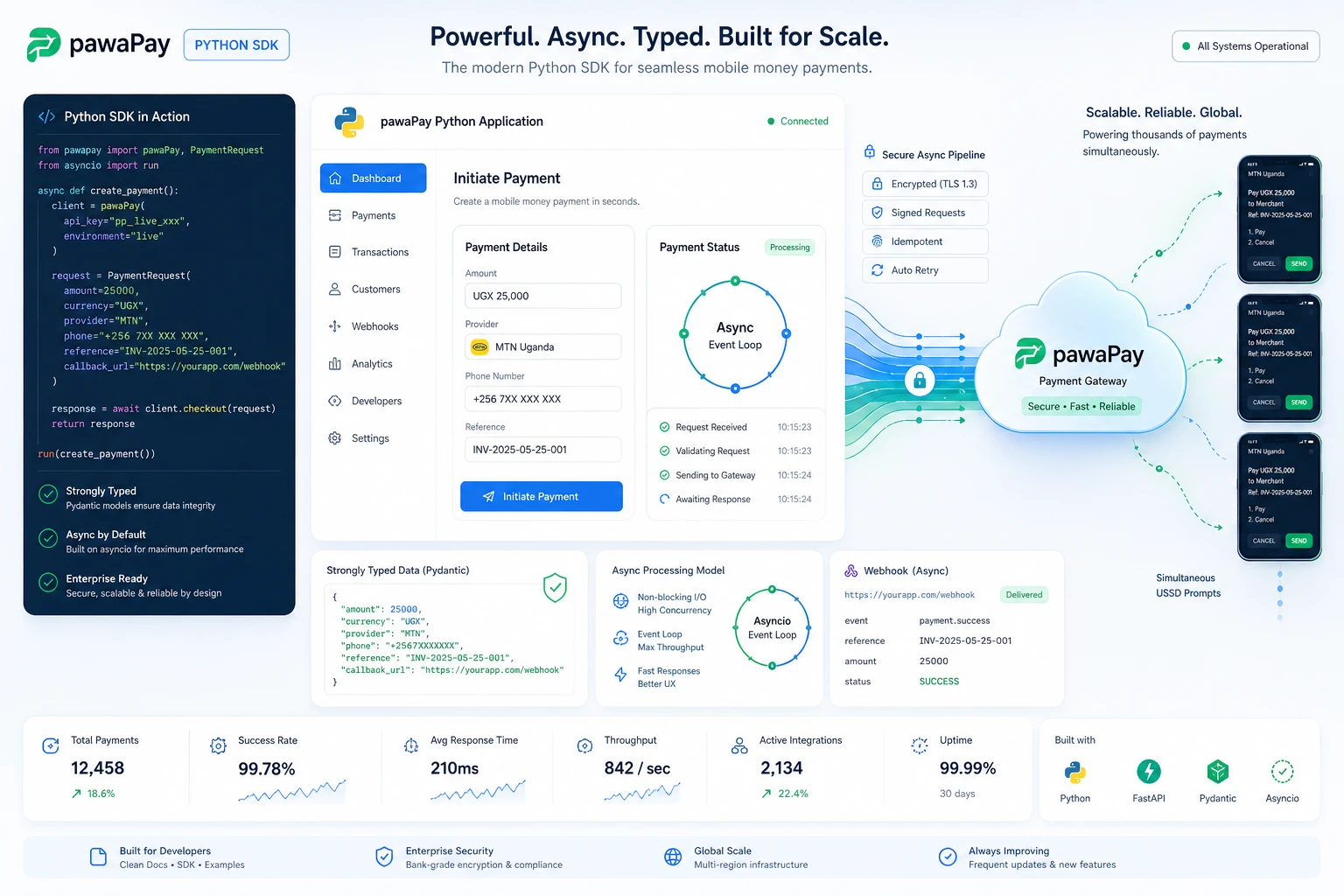
pawaPay Python SDK: Seamless enterprise mobile money integration for Python applications. Features robust typing and asynchronous transaction handling.
pawaPay Node.js SDK, Payments
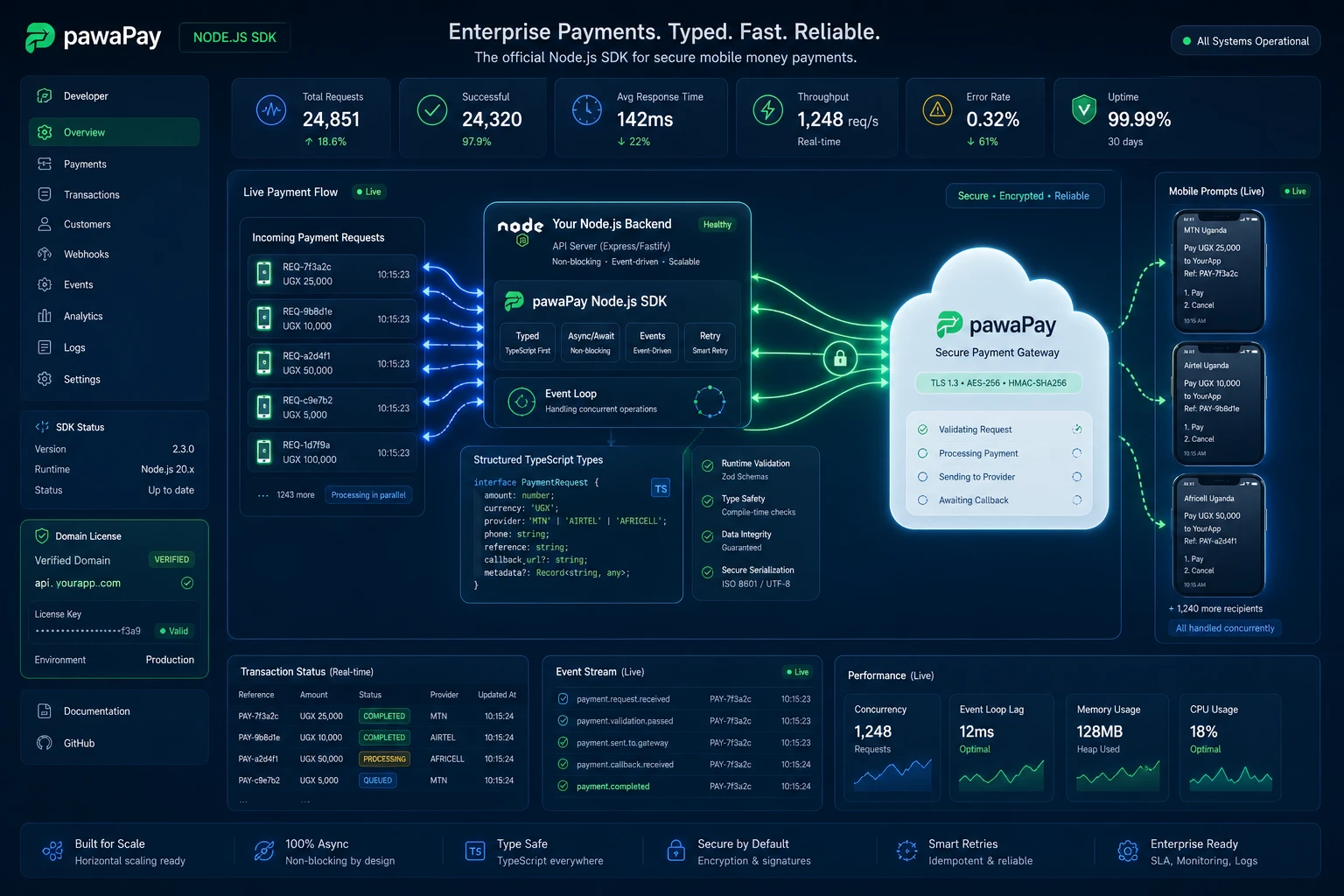
pawaPay Node.js SDK: Enterprise mobile money integration for Node.js & TypeScript. Strictly typed, async wrapper with simple domain-based licensing.
Clean My Mind - A Quiet Release

A privacy-first web ritual, no signup, say one sentence and let it go. Built with vanilla JavaScript, local-only storage, and focused on presence rather than analytics.
Professional Services
© Copyright 2026 - Katorymnd Web Solutions - All Rights Reserved. Registered with Uganda Registration Services Bureau.