
Python Fault-tolerant Gateway: Mno Network Drops & Retries
Date: 2026-04-27 || Views: 846
Fault-Tolerant Gateway Design: Handling African MNO Network Drops in Python
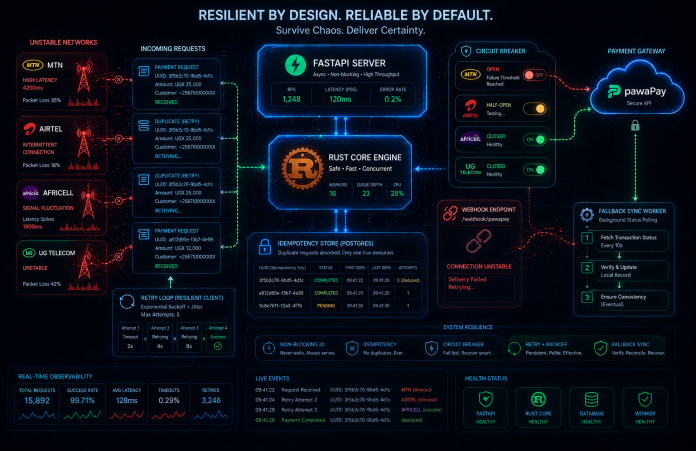
Designing a payment gateway for African mobile network operators requires abandoning the illusion of the "happy path." In this ecosystem, network latency is highly erratic, USSD prompts routinely time out, and silent connection drops are a daily operational reality. Building a system that assumes every HTTP request will return a clean, immediate response is architectural negligence. When a network connection drops mid-transaction, an improperly designed backend will either drop the transaction entirely or accidentally retry the request, resulting in catastrophic double-charging. The pawaPay Python SDK is specifically engineered to survive this hostile networking environment by combining memory-safe Rust execution with asynchronous Python orchestration.
The Idempotency Mandate
The most dangerous scenario in mobile money integration occurs during the initiation phase. When your Python backend dispatches a deposit request to the PawaPay gateway, the connection might drop precisely after the payload leaves your server but before the gateway's acknowledgment returns. At this exact millisecond, your application enters a state of critical uncertainty. It does not know if the mobile network operator is processing the payment or if the request vanished into the void.
Attempting to blindly retry the request is the primary cause of double-spends. To surgically neutralize this, the SDK enforces strict client-side idempotency. Every transaction must be initiated with a uniquely generated UUID acting as the primary key. If your server experiences a timeout exception and executes a retry loop, the Rust core transmits the exact same UUID in the payload. The PawaPay gateway recognizes this duplicate identifier, ignores the redundant execution request, and safely returns the state of the original transaction. This mathematical guarantee allows your gateway to retry aggressively during network drops without ever risking your customers' funds.
Overcoming the Webhook Vacuum
The second architectural pillar of fault tolerance is acknowledging that webhooks will inevitably fail. While asynchronous webhooks are the primary mechanism for receiving terminal transaction states, relying on them exclusively creates a critical vulnerability known as the webhook vacuum. A customer might successfully enter their PIN and complete the transaction, but a momentary DNS failure, a firewall misconfiguration, or an overloaded server queue could prevent the webhook from reaching your listener endpoint. The transaction remains eternally "pending" in your database, locking the user out of their purchased service.
To achieve true fault tolerance, your architecture must implement an active status synchronization fallback. Your system should utilize a background task orchestrator to continuously sweep your database for transactions that have remained in a pending state beyond the standard USSD timeout window. The SDK provides a dedicated status-checking method designed exactly for this reconciliation phase. By asynchronously querying the PawaPay gateway for these orphaned transaction IDs, your application forcefully pulls the terminal state into your database, completely bypassing the reliance on the webhook delivery network.
Implementing Asynchronous Circuit Breakers
Catastrophic network failures do occur, particularly when specific mobile network operators undergo unscheduled maintenance. During a total provider outage, thousands of checkout requests will inevitably fail, resulting in cascading latency across your entire infrastructure. If your application continues to stubbornly route traffic to a dead provider, you will rapidly exhaust your connection pools and crash your own application.
To contain the blast radius of a provider outage, your gateway must implement an asynchronous circuit breaker pattern. Because the SDK utilizes non-blocking I/O, it can efficiently monitor the failure rates of specific providers in real-time. If the SDK begins throwing consecutive timeout exceptions or gateway errors for a specific mobile network operator, your backend logic should temporarily trip the circuit for that provider. Subsequent checkout attempts for that specific network should immediately fail fast with a graceful error message to the user, completely avoiding the network overhead. Meanwhile, traffic routed to healthy providers remains entirely unaffected.
Graceful Degradation
Fault tolerance is not the impossible goal of preventing network failures; it is the architectural discipline of containing them. By combining the immutable transaction formatting of the native Rust core with aggressive idempotency, active state reconciliation, and intelligent circuit breaking, you transform your Python backend from a fragile script into a highly resilient financial gateway. The system stops fighting the chaos of mobile networks and instead degrades gracefully, ensuring transaction integrity regardless of the underlying infrastructure conditions.

Glimpses of Greatness Crafted by Katorymnd
Dive into the journeys of clients I've empowered.
Click any project below to explore the results - each one a story of transformation.
pawaPay Java SDK - Payment Integration


pawaPay Java SDK: Seamless enterprise mobile money integration for Java applications. Features robust typing, thread-safe execution, and reliable transaction handling.
pawaPay Python SDK - Payment Integration
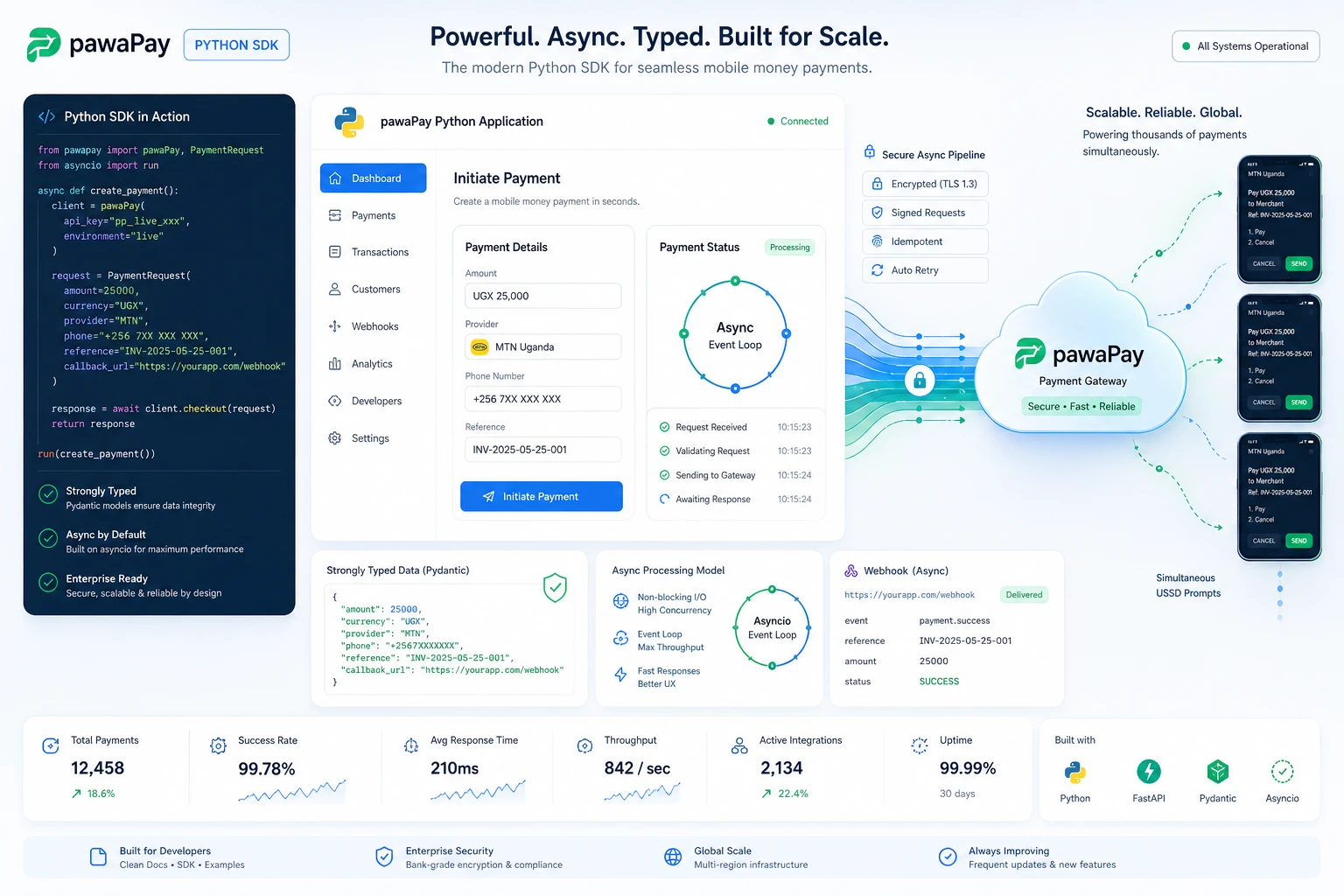
pawaPay Python SDK: Seamless enterprise mobile money integration for Python applications. Features robust typing and asynchronous transaction handling.
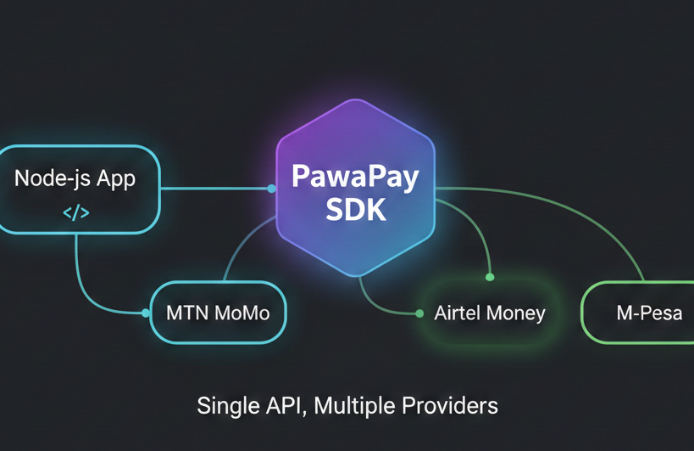
pawaPay Node.js SDK, Payments
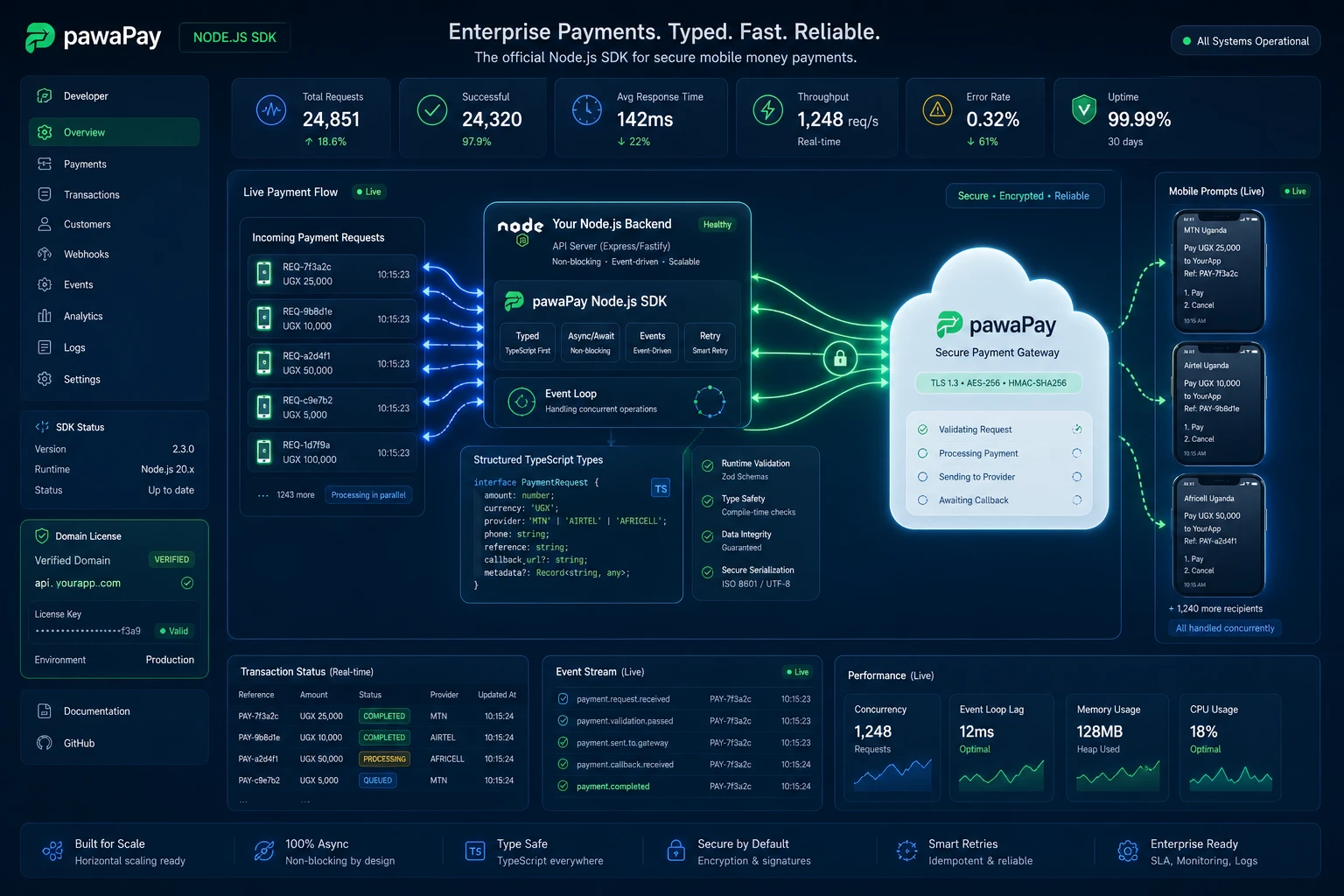
pawaPay Node.js SDK: Enterprise mobile money integration for Node.js & TypeScript. Strictly typed, async wrapper with simple domain-based licensing.
Clean My Mind - A Quiet Release

A privacy-first web ritual, no signup, say one sentence and let it go. Built with vanilla JavaScript, local-only storage, and focused on presence rather than analytics.
Professional Services
© Copyright 2026 - Katorymnd Web Solutions - All Rights Reserved. Registered with Uganda Registration Services Bureau.