

Pawapay Python Sdk: Async Mobile Money Checkout Tutorial
Date: 2026-04-27 || Views: 1,234
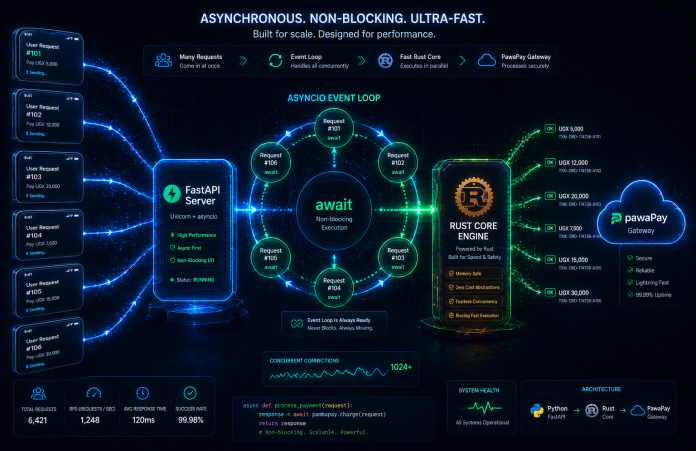
Async Mobile Money in 5 Minutes: A Surgical Quick-Start Guide to Non-Blocking Payments
African mobile network operators are notorious for unpredictable latency. When a user taps the checkout button, the request travels from your server to the PawaPay gateway, then to the local telco, and finally triggers a USSD push on the user's device. If your Python backend relies on traditional, synchronous HTTP libraries, your server thread halts entirely while waiting for that round-trip to complete. A sudden spike in checkout traffic will rapidly exhaust your worker threads, causing your application to drop connections and crash under its own weight.
The pawaPay Python SDK eliminates this architectural bottleneck entirely by leveraging Python's native asyncio framework paired with a Rust-powered asynchronous HTTP client. In this guide, we will implement a high-throughput, non-blocking checkout endpoint in under five minutes.
Initializing the Environment
Before writing the execution logic, your environment must be initialized and cryptographically bound. You need to install the SDK via your package manager and execute the setup command to generate your local hardware imprint. Once your environment is locked, place your sandbox API token and your generated SDK license key inside your environment file. The SDK is designed to eagerly load these credentials natively, ensuring that your master secrets remain out of your application source code.
The Asynchronous Implementation
To demonstrate the non-blocking architecture, we will utilize FastAPI, a modern, high-performance web framework designed specifically for asynchronous Python. The following code block represents a complete, production-ready routing logic for initiating a mobile money deposit.
import os
import asyncio
from fastapi import FastAPI, HTTPException
from fastapi.responses import JSONResponse
from dotenv import load_dotenv

from src.api.ApiClient import ApiClient
from src.utils.helpers import Helpers

load_dotenv()
app = FastAPI(title="Async Checkout Gateway")

config_dict = {
    'api_token': os.environ.get("PAWAPAY_SANDBOX_API_TOKEN"),
    'environment': 'sandbox',
    'api_version': 'v2',
    'ssl_verify': False,
    'license_key': os.environ.get("KATORYMND_PAWAPAY_SDK_LICENSE_KEY")
}

client = ApiClient(config_dict)

@app.post("/api/checkout")
async def process_payment(phone: str, amount: str):
    deposit_id = Helpers.generate_unique_id()

    try:
        response = await client.initiate_deposit_v2(
            deposit_id=deposit_id,
            amount=amount,
            currency="UGX",
            payer_msisdn=phone,
            provider="MTN_MOMO_UGA",
            customer_message="Async SDK Checkout"
        )

        if response.get("status") in [200, 201, 202]:
            return JSONResponse(content={
                "message": "Push notification sent to device.",
                "deposit_id": deposit_id,
                "status": "ACCEPTED"
            })

        raise HTTPException(status_code=400, detail="MNO rejected the initiation.")

    except Exception as e:
        raise HTTPException(status_code=500, detail="SDK Execution Error")
The Architectural Breakdown
The magic of this implementation lies entirely within the await keyword. When the initiate_deposit_v2 method is called, the Python wrapper serializes the payload and hands it over to the Rust core. Crucially, Python does not freeze while waiting for the network request to travel to PawaPay.
Instead, the await keyword instantly yields control back to the Uvicorn event loop. If one hundred other users hit the checkout endpoint at that exact millisecond, the server will cheerfully accept and begin processing all of their requests simultaneously. Once the Rust core receives the network response from the payment gateway, it signals the Python event loop to resume that specific function and return the JSON response to the correct client.
Achieving Maximum Throughput
Transitioning from synchronous scripts to an asynchronous architecture is not merely a micro-optimization; it is a fundamental requirement for scaling fintech applications. By utilizing the pawaPay Python SDK alongside an async framework, your application can handle thousands of concurrent payment initiations on a single server node. This ensures that your infrastructure remains resilient, highly responsive, and surgically precise, effectively decoupling your server's performance from the unpredictable latency of external mobile networks.


Explore how Predictive UX and personalization are transforming web design...
Glimpses of Greatness Crafted by Katorymnd
Dive into the journeys of clients I've empowered.
Click any project below to explore the results - each one a story of transformation.
pawaPay Java SDK - Payment Integration


pawaPay Java SDK: Seamless enterprise mobile money integration for Java applications. Features robust typing, thread-safe execution, and reliable transaction handling.
pawaPay Python SDK - Payment Integration
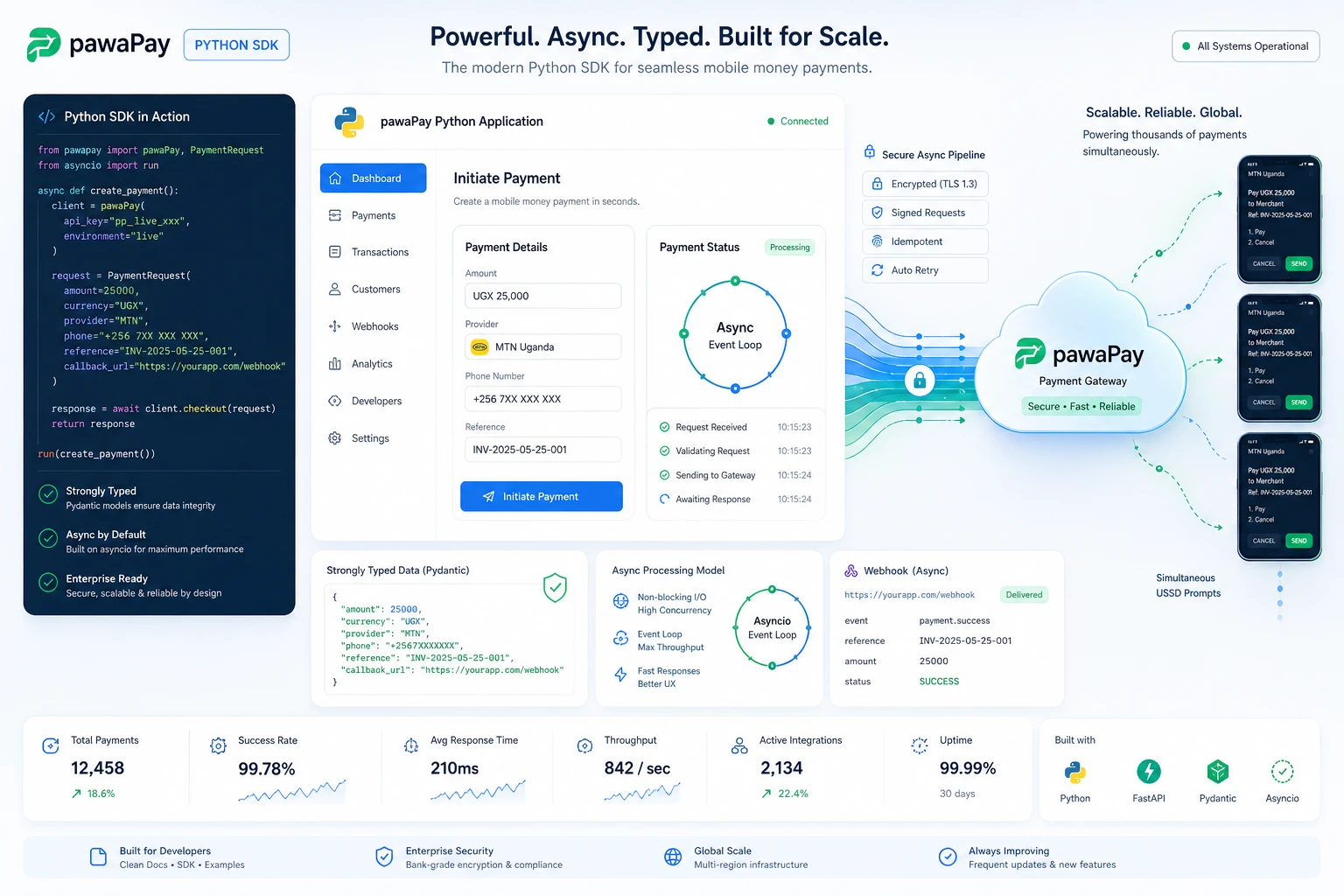
pawaPay Python SDK: Seamless enterprise mobile money integration for Python applications. Features robust typing and asynchronous transaction handling.
pawaPay Node.js SDK, Payments
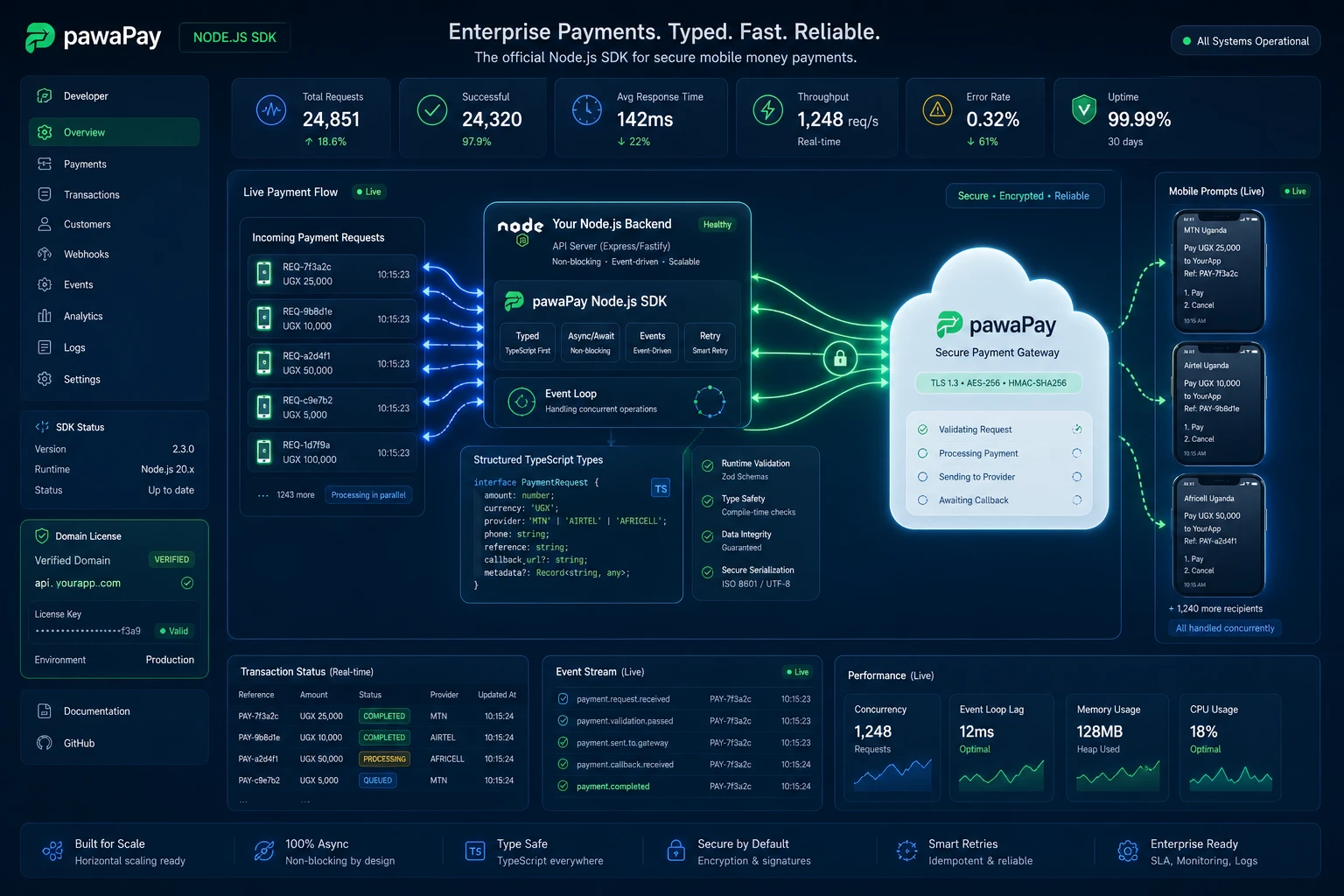
pawaPay Node.js SDK: Enterprise mobile money integration for Node.js & TypeScript. Strictly typed, async wrapper with simple domain-based licensing.
Clean My Mind - A Quiet Release

A privacy-first web ritual, no signup, say one sentence and let it go. Built with vanilla JavaScript, local-only storage, and focused on presence rather than analytics.
Professional Services
© Copyright 2026 - Katorymnd Web Solutions - All Rights Reserved. Registered with Uganda Registration Services Bureau.